



Executive Summary
The AI landscape has shifted. It’s no longer about how often you use the technology, it’s about whether you can prove it’s working. Organizations that succeed recognize that measuring ROI is not a downstream reporting exercise but a core capability that shapes how AI is perceived, governed, and ultimately adopted. The ability to measure ROI effectively is inseparable from organizational trust in AI, creating a reinforcing cycle between proof and confidence. Ultimately, trust acts as the bridge between measuring AI and scaling it; strong measurement frameworks increase confidence and that confidence accelerates broader, more ambitious adoption.
In January 2026, Atlassian commissioned Forrester Consulting to evaluate the relationship between AI measurement, AI trust, and AI adoption. Forrester conducted an online survey with 469 decision-makers in North America, EMEA, and APAC and four interviews in North America and EMEA. The respondents were leaders in their organizations’ AI strategy.
This study found that organizations with stronger measurement practices also report higher levels of AI trust and adoption. Whether trust enables measurement maturity or develops alongside it, the two are closely intertwined. In fact, 82% of respondents whose organizations have more mature measurement practices agree that without organizational trust in AI, it is difficult to build effective ROI measurements, compared with just 54% of respondents whose organizations have less mature measurement practices.
82 %
of ROI leaders agree that it’s difficult to build ROI measurements without organizational trust in AI. Just 54% of ROI emergers agree.
Key Findings
-
AI adoption is broad but uneven. Organizations are taking a measured approach to AI adoption, prioritizing lower-risk applications as they build their AI strategies. The survey found the most adopted AI use cases are in areas where consequences for hallucinations are lower. For example, 58% of respondents adopted AI for process automation use cases, but only 31% adopted AI for risk, fraud, or compliance use cases.
-
ROI maturity varies significantly across organizations. Organizations are at different stages in their ability to measure and realize the value of AI. While 36% of respondents report achieving significant or transformational impact from AI (ROI leaders), 31% are still seeing limited returns due to less mature measurement approaches (ROI emergers).
-
Data quality is a barrier — ROI emergers feel it most. Transparency in AI outputs depends on the quality and traceability of the data feeding those decisions. However, poor or inconsistent data quality was cited as a main barrier to building trust in AI as a technology across all respondents. ROI emergers specifically said that a fragmented data foundation is the top barrier preventing their organization from scaling AI initiatives.
-
Trust and ROI measurement are tightly associated for ROI leaders. Mature organizations understand that AI trust is a catalyst for success — 82% of ROI leaders agree that without organizational trust in AI, it is difficult to build effective ROI measurements, compared to 54% of ROI emergers.
The State Of AI Adoption: Broad But Uneven
Artificial intelligence has become a central priority for organizations, with adoption expanding rapidly across functions, teams, and use cases in pursuit of greater efficiency and productivity. But deploying AI is only part of the equation. To realize its full value, companies need disciplined approaches to evaluate performance and measure return on investment. This measurement is not just about accountability; it is essential for building organizational trust and sustaining long-term adoption. Despite widespread implementation, many organizations have yet to establish consistent ways to assess AI’s impact. The data shows a clear pattern: Organizations first adopt AI in areas where the cost of being wrong is low, and their ROI strategy follows the same logic. Forrester research found that:
-
AI adoption follows the path of least resistance. The two most popular AI use cases are operations and process automation, with 58% of respondents reporting adoption, followed closely by 55% reporting customer engagement and experience (see Figure 1). In contrast, the least adopted use cases are human resource optimization (24%) and risk, fraud, and compliance (31%). This suggests organizations are taking a measured approach to AI adoption, prioritizing lower-risk applications as they build their AI strategies. After all, a hallucination in a compliance workflow carries far greater consequences than one in an operational process.
-
Organizations are deploying AI faster than they can measure its results. We asked respondents how successfully they can measure the ROI of 10 AI use cases and found that, for 80% of the use cases evaluated, fewer than half report confidence in their ability to measure ROI (see Figure 2). Interestingly enough, the most adopted use cases are not the most successfully measured. In fact, only 31% of respondents feel confident in their organization’s ability to measure operational and process automation, which is the top use case.
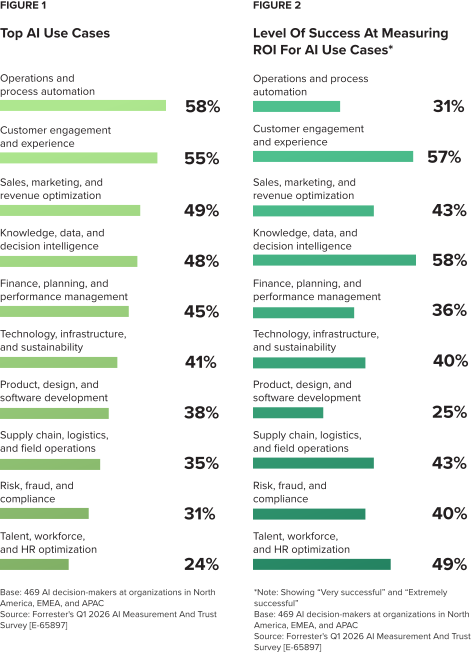
Confidence in measuring ROI is linked to the type of metrics used to measure each use case. For example, activity-based metrics, such as employee productivity, are easier to measure than operational-based metrics, such as competitive advantage. Some AI use cases cater to easy ROI measurement because they are linked more directly to activity-based metrics. For example, when comparing the two most adopted use cases, respondents are more confident in their ability to measure customer engagement and experience because CX initiatives are easier to evaluate through activity-based metrics, whereas operations and process automation rely on more complex operational metrics.
Fewer than half of respondents report confidence in their ability to measure ROI of most use cases
ROI Leaders And Emergers: Two Distinct Groups Based On AI Measurement Practices
For this study, we classified respondents into two groups based on their ability to measure the ROI of AI. Respondents who say their organizations’ AI investments have contributed zero to slight business improvements are classified as ROI emergers. Respondents who say their organizations’ AI investments have contributed to significant or transformational improvement are classified as ROI leaders (see Figure 3).
POLL
Figure 3
To what extent has AI led to measurable improvements to your business?
Base: 469 AI decision-makers at organizations in North America, EMEA, and APAC (145 ROI emergers, 171 ROI leaders)
Source: Forrester's Q1 2026 AI Measurement And Trust Survey [E-65897]
How ROI Leaders And Emergers Differ
Although ROI leaders and emergers share some common perspectives, important differences emerge between the two groups. While all respondents are focused on ROI, ROI leaders tend to view AI through a broader business lens than ROI emergers, who are more heavily focused on improving foundational data practices. Forrester’s data found that:
-
Revenue impact is the easy ROI story. Fifty-six percent of ROI leaders said they were measuring the revenue impact of AI, a top response for that segment. Surprisingly, 45% of ROI emergers said the same thing (see Figure 4). We attribute this to the relative ease of tracking revenue growth as a visible, short-term business metric.
-
Competitive advantage and cost reduction divide ROI leaders from ROI emergers. The most substantial difference between ROI leaders and emergers is that ROI leaders measure market differentiation and cost reduction, while ROI emergers are focused on reducing costs. While productivity and risk are important starting points, ROI leaders extend beyond foundational metrics to measure broader, less tangible business impact.
-
ROI leaders are more confident in their ability to measure ROI for all use cases. The CIO of a global technology conglomerate (an ROI leader) explained: “We are totally successful in being able to measure the ROI of our use cases. The ROI isn’t always the outcome we want it to be, but the measurement is very clear.” This is a stark contrast with a CIO from a global manufacturing company (an ROI emerger) who said: “Our ability to measure ROI depends on the use case. We need to understand what kind of savings we want to obtain.”
-
Weak data practices explain why ROI emergers lag. ROI emerger respondents said that a fragmented data foundation is the top barrier preventing their organizations from scaling AI initiatives. This challenge helps explain not only why ROI emergers are less mature in their AI adoption efforts, but also why they struggle more with AI ROI measurement. AI systems are only as effective as the data that fuels them, and fragmented or low-quality data limits organizations’ ability to generate reliable outputs, measure meaningful business impact, and build confidence in AI-driven decisions. In this sense, data serves as the connective tissue between AI adoption, trust, and measurable ROI.
The most substantial difference between ROI leaders and emergers is that ROI leaders measure market differentiation and cost reduction, while ROI emergers are focused on employee productivity and risk reduction
Figure 4
“What types of specific metrics does your organization define and use to measure the benefits of AI investment today?”
[CONTENT]
Note: Showing top nine responses
Base: 469 AI decision-makers at organizations in North America, EMEA, and APAC (145 ROI emergers, 171 ROI leaders)
Source: Forrester's Q1 2026 AI Measurement And Trust Survey [E-65897]
Data Quality, Governance, And Trust
Building trust in AI is no longer just a governance challenge; it is becoming a prerequisite for scaling adoption and achieving measurable business impact. The data makes this link concrete: 82% of respondents from ROI leader organizations agree that without organizational trust in AI, it is difficult to build effective ROI measurements, compared to just 54% of respondents from ROI emerger organizations. Organizations must not only strengthen the quality and transparency of the data behind AI systems but also ensure that trust is consistently shared across leadership, management, and frontline employees. As trust gaps emerge across organizational levels and business functions, they can slow adoption and weaken organizations’ ability to effectively measure and scale AI initiatives. Conversely, organizations that prioritize trust through stronger data practices, transparency, and governance are better positioned to accelerate adoption and achieve their strategic AI goals. Forrester research found that:
-
Trust in data is not uniformly distributed within organizations. Respondents indicated that executive ROI leaders are significantly more likely to trust the ability of AI tools to secure data compared to management or frontline employees (see Figure 5). This finding is critical, because in many cases, managers and frontline employees are directly using AI tools, indicating that executives’ confidence may be misplaced.
-
A lack of trust is limiting AI adoption. Respondents report that trust concerns are limiting adoption in critical functions such as finance, HR, risk and compliance, and product. This lack of trust is directly affecting adoption, as we saw use cases for finance, HR, and risk and compliance were not widely adopted.
Figure 5
Level Of Trust In AI Tools By Group
Note: Individual percentage values may not sum to totals due to rounding.
Base: 469 AI decision-makers at organizations in North America, EMEA, and APAC
Source: Forrester's Q1 2026 AI Measurement And Trust Survey [E-65897]
-
Transparency and data quality are the top barriers to trust. The top barriers to building trust in AI as a technology are lack of transparency and poor data quality (see Figure 6). These challenges are deeply interconnected, as transparency in AI decision-making depends on the quality, governance, and traceability of the data used to train AI systems and generate outputs.
The interviewed CIO at a global technology conglomerate noted, “When people ask, ‘Can I trust the quality of AI?,’ in many cases, it’s ‘Can I trust the quality of the process and data?’ which is being used to train the AI.”
Transparency in AI decision-making depends on the quality, governance, and traceability of the data used to train AI systems and generate outputs
POLL
Figure 6
What are the main barriers to building trust in AI as a technology within your organization? (Select all that apply)
Note: Showing top six responses.
Base: 469 AI decision-makers at organizations in North America, EMEA, and APAC
Source: Forrester's Q1 2026 AI Measurement And Trust Survey [E-65897]
The CIO at a global manufacturing company added: “If you don’t have a data governance model in place when you start with AI, it’s really an issue. [A data governance model] is extremely beneficial, but it takes a lot of time.”
-
Organizations that prioritize AI trust are more likely to meet their AI goals. ROI leaders are significantly more likely to agree that prioritizing trust in AI makes organizations better positioned to achieve their strategic goals and that increasing trust in AI will accelerate AI adoption (see Figure 7).
-
Organizational trust is a prerequisite for effective ROI measurement. ROI leaders (82%) are more likely than ROI emergers (54%) to believe that without organizational trust in AI, it is difficult to build effective ROI measurement.
Figure 7
“How much do you agree with the following statements?” (Showing "Agree" and "Completely agree")
[CONTENT]
Note: Showing top four responses.
Base: 469 AI decision-makers at organizations in North America, EMEA, and APAC (145 ROI emergers, 171 ROI leaders)
Source: Forrester's Q1 2026 AI Measurement And Trust Survey [E-65897]
Key Recommendations
To move from isolated AI pilots to measurable business impact, organizations must treat trust and measurement as mutually reinforcing capabilities. The survey results show that firms with mature ROI measurement practices report higher levels of trust in AI and broader adoption. The following recommendations focus on building the transparency, data foundations, and organizational alignment needed.
Forrester’s in-depth survey of AI strategy leaders across North America, EMEA, and APAC yielded several important recommendations for strengthening AI trust, improving ROI measurement, and accelerating adoption.
Appendix A: Methodology
In this study, Forrester conducted an online survey of 469 decision-makers and four qualitative interviews at organizations in North America, EMEA, and APAC to evaluate AI trust and measurement. Survey participants included decision-makers in IT and software development or engineering. Questions provided to the participants asked about their use of AI, AI measurement practices, and AI sentiment. Respondents were offered a small incentive as a thank-you for time spent on the survey. The study began in December 2025 and was completed in January 2026.
Appendix B: Demographics/Data
Region
| North America | 33% |
| EMEA | 33% |
| APAC | 34% |
Annual Revenue
| $500M to $999M | 39% |
| $1B to $5B | 42% |
| Over $5B | 19% |
Top 4 Industries
| Technology and/or technology services | 13% |
| Financial services and/or insurance | 12% |
| Healthcare | 11% |
| Telecommunication services | 10% |
Respondent Level
| C-level | 23% |
| Vice President | 35% |
| Director | 42% |
Respondent Department
| IT | 66% |
| Software development/ engineering | 34% |
Consulting Team:
Vanessa Fabrizio, Senior Market Impact Consultant
Contributing Research:
Forrester’s Data, AI, and Analytics research group
Published
November 2026
 PDF