



Executive Summary
AI is becoming increasingly embedded in core workflows in the finance industry. As organizations face rising volatility, growing operational complexity, and increasing pressure to deliver timely and accurate insights, AI is becoming fundamental to how finance operates. While early adoption focused on automation and efficiency, finance leaders now expect AI to support higher‑value outcomes such as forecast accuracy and earlier risk identification.
In this environment, trust becomes central to broader AI adoption. As AI is more frequently implemented in execution and decision‑making processes, the ability to govern outcomes, trace inputs, and enforce controls becomes essential. Without this foundation, progress toward more autonomous finance workflows will remain limited.
As a result, organizations are taking a more deliberate approach to scaling AI. Rather than pursuing broad rollouts, many are strengthening existing deployments and advancing autonomy gradually. This is supported by hybrid delivery models, where finance retains ownership of workflows while leveraging external platforms and partners to provide point solutions, integrate data across systems, and orchestrate end‑to‑end workflows.
In February 2026, Airwallex commissioned Forrester Consulting to understand how finance leaders are navigating the shift at early adoption in comparison to the realities of scaling AI across complex environments. Forrester surveyed 1,279 finance decision‑makers and interviewed six finance leaders across 11 markets to provide insights into the barriers that emerge beyond initial deployment, and how orchestrating data, workflow systems, and human judgement can sustainably advance AI adoption.
Key Findings
-
AI is moving up the value chain from efficiency gains to real time insights and decision support. AI is increasingly expected to anticipate business needs: More than half of decision makers prioritise diagnostic (56%) and predictive capabilities (52%) to inform their organization’s financial decisions.
-
Data fragmentation persists despite platform consolidation. While 44% of decision-makers rely on a small number of core platforms for most finance workflows, fragmented data (65%) and integration complexity (61%) remain top technology challenges. Manual consolidation remains prevalent, with 84% still relying on it to complete finance workflows.
-
AI development is outpacing finance teams’ ability to build the required skills. Fifty-three percent of decision-makers cite skills gap as a barrier to scaling AI. Meanwhile, 54% remain focused on basic AI literacy and AI workflow development training for selected staff over enterprisewide talent strategies.
-
Finance teams are shifting from AI users to builders. With 55% of decision‑makers expecting finance teams to play a direct role in building AI‑enabled workflows, there will be greater accountability for how AI is applied across core finance and business decisions.
-
Finance leaders are scaling AI through a hybrid model by combining in-house and external expertise. In the next 12 months, 57% plan to use a mix of internal development and external vendor solutions, rather than fully building or outsourcing AI capabilities.
Finance Leaders Plan To Advance AI Into Judgement-Heavy Tasks, But Trust Comes First
Finance teams are increasingly embedding AI into their operations, alongside its mandate of control and accountability. As leaders look beyond task-level automation, the next value frontier is decision support — enabling earlier visibility into risks, more robust scenario planning, and faster, higher-confidence decisions.
However, in an environment with a low tolerance for error, scaling AI is constrained not by technology alone, but by the ability to trust and control its outputs. Finance teams are accountable for outcomes that must be auditable, defensible, and compliant, thereby raising the benchmark for adoption.
-
AI adoption now ranks alongside finance teams’ core mandate of control and accountability as a top priority. Strengthening financial controls, audit readiness, and compliance remain the top priority for 75% of respondents, while 74% prioritize integrating AI into finance workflows and improving enterprise resilience (see Figure 1). This indicates that AI is no longer treated as a standalone transformation agenda but is however closely associated with the key responsibilities that define the finance function.
This shift reflects a broader change in expectations toward AI. As volatility rises and decision cycles accelerate, finance teams increasingly expect AI to deliver foresight rather than efficiency. Anticipating business needs, risks, and opportunities (57%) now ranks alongside end-to-end automation (56%) as top drivers for AI adoption (see Figure 2). This marks a transition from productivity led adoption to insight driven value.
Figure 1
Top Five Strategic Priorities For Finance Functions Over The Next 12 Months
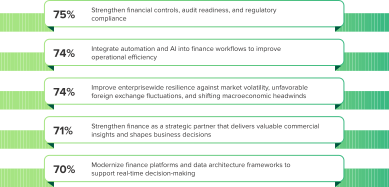
Note: Showing priorities that decision-makers ranked within their top five.
Base: 1,279 global decision-makers with responsibility and/or influence in the organization’s financial operations
Source: Forrester's Q1 2026 Intelligent Finance Operations Survey [E-66799]
POLL
Figure 2
What Is The Top Primary Driver Behind Your Organization’s AI Adoption Plans In Finance? (Select one)
Note: Showing drivers that decision-makers ranked within their top three.
Base: 1,279 global decision-makers with responsibility and/or influence in the organization’s financial operations
Source: Forrester's Q1 2026 Intelligent Finance Operations Survey [E-66799]
-
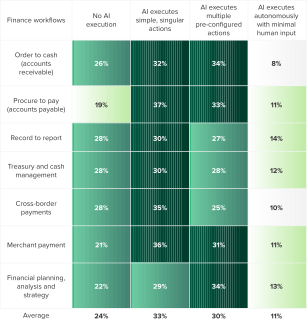
Yet, finance teams take a cautious approach to scaling AI: They build trust in outputs before enabling autonomy. On average, AI supports 63% of core finance workflows for simple or pre-configured tasks, while only 11% of workflows are executed autonomously with minimal human input (see Figure 3).
Figure 3
Current AI Execution Levels Across Core Finance Workflows
Base: 1,279 global decision-makers with responsibility and/or influence in the organization’s financial operations
Source: Forrester's Q1 2026 Intelligent Finance Operations Survey [E-66799]
This measured pace of autonomy is more evident in high-stakes areas such as audits, controls, and reporting, where accuracy is non-negotiable. As a vice president of finance and strategy at a telecommunications company in Singapore notes: “Finance teams tend to be more conservative than other functions because accuracy is non-negotiable, and even small errors can create significant downstream work. This drives skepticism toward new tools, particularly around reliability and audit defensibility. When the stakes are audits, controls, and reporting integrity, that caution becomes even stronger.”
-
Structured workflows are the starting point for building trust in AI in finance. Transaction-heavy processes (e.g., procure-to-pay, order-to-cash, merchant payments) show some of the highest levels of AI execution because they run on repeatable steps, defined thresholds, and have clearer exception paths — making outputs easier to validate and control. Most organizations leverage AI for simple or pre-configured tasks across these workflows, which are usually the first processes to gain traction. These early wins build trust and establish the operating discipline needed for AI expansion.1
-
Once trust is established in structured workflows, AI moves into decision support for more judgement-intensive work. As confidence in AI outputs grows, organizations apply AI to strategic finance areas such as corporate development and investor relations, where AI augments analysis and forecasting in support of business decisions.
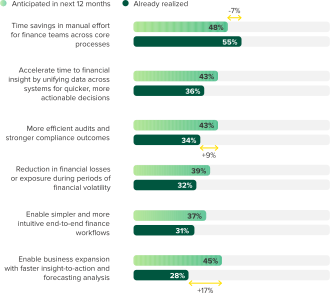
With AI being increasingly used to inform core business decisions, expectations for outcomes move beyond efficiency gains and toward broader business impact. Organizations are increasingly prioritising outcomes such as business expansion, faster insight to action, and improved compliance over the next 12 months (see Figure 4). This reflects a deliberate progression, with organizations only expanding AI once outputs are validated and trusted within control frameworks.2
Figure 4
AI Outcomes In Finance Workflows (Current Vs. Next 12 Months)
Base: 1,279 global decision-makers with responsibility and/or influence in the organization’s financial operations
Source: Forrester's Q1 2026 Intelligent Finance Operations Survey [E-66799]
Fragmented Data and Integration Complexity Hinder AI Expansion In Finance
The lack of trusted, consistent, and governed data erodes confidence in AI outputs, limiting its ability to deliver foresight and enterprise level value. In practice, that foundation often breaks down across regions, entities, and platforms.3 Distributed and federated data architectures create fragmentation that undermines AI execution. While consolidation can reduce the number of systems, it does not automatically deliver end-to-end connectivity. Orchestration fills this gap by aligning how data, systems, workflows, and human judgement interact from end to end, ensuring information moves reliably across processes.
-
Fragmented and inconsistent finance data is the primary barrier to scaling AI. Sixty-five percent of decision-makers cite it as the leading technology challenge, followed closely by 61% who cite integration complexity across regions, entities, and providers as another barrier (see Figure 5). Fragmentation across data, workflows, entities, and regions often leaves AI operating on incomplete or inconsistent context, increasing the risk of inaccurate insights and reducing trust. Traditional sectors like travel and hospitality, media and entertainment, and advertising also tend to advance more slowly in AI execution, reflecting more fragmented data environments and less standardized workflows in these sectors.
-
This challenge intensifies as organizations move beyond initial AI adoption. In the early stages of adopting AI, organizations are primarily constrained by the need to monitor and validate AI outputs (76%). However, as AI expands into broader workflow execution across entities and regions, the bottleneck shifts back to data fragmentation (63% to 68%) and integration complexity (60% to 64%). Over time, as teams can no longer trace inputs, validate outputs across systems, or enforce policies from end to end, accountability and auditability begin to wear away.4
Figure 5
Effectiveness Of DAP In Achieving Business Outcomes By Maturity Level
Click to see data by region Hover to highlight data by countries, click to hide countries from the chart for comparison.
[CONTENT]
Base: 1,279 global decision-makers with responsibility and/or influence in the organization’s financial operations
Source: Forrester's Q1 2026 Intelligent Finance Operations Survey [E-66799]
71 %
of decision-makers in Germany and France cite integration complexity as the top barrier to scaling AI at their organizations.
-
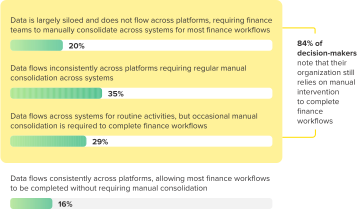
Platform consolidation has not translated into connected finance workflows: Orchestration is the missing layer. While 44% of decision-makers have consolidated their organization’s finance platforms and operate on a small number of core platforms, this has not resulted in end-to-end connectivity. Data remains fragmented, with 84% still requiring manual steps to complete finance workflows (see Figure 6). Partial consolidation has yet to deliver fully-connected finance workflows, leaving organizations with manual handoffs and limited end-to-end visibility. End-to-end execution depends on the effective integration of data, systems, workflows, and human judgement to ensure information moves reliably across processes.5
While finance leaders recognize that finance platforms often cover different parts of the workflows, the opportunity lies in moving closer to a more connected finance ecosystem. AI-native and API-first platforms can help consolidate financial data, connect workflows, and provide the foundation for AI to execute more autonomously across multiple processes within finance teams.
Figure 6
Data Flow Across Organization's Finance Platforms
Base: 1,279 global decision-makers with responsibility and/or influence in the organization’s financial operations
Source: Forrester's Q1 2026 Intelligent Finance Operations Survey [E-66799]
Gaps In Organizational Readiness Amplify Challenges In AI Adoption
As AI adoption progresses from isolated use cases into connected workflows, the primary challenge shifts from technology implementation to organizational readiness. Success increasingly hinges on not only better AI solutions, but on the organization’s ability to operate it effectively in daily finance operations.6 This requires finance teams to develop the necessary skill sets to operate AI-enabled workflows, overcome internal resistance to new ways of working, and establish clear governance.
-
Finance teams still lack the capabilities to operate AI at scale. More than half of decision-makers (53%) cite limited experience in running AI-enabled finance processes as a key constraint to operating AI extensively (see Figure 7). While most decision-makers (54%) focus on building basic AI literacy and training selected staff to develop AI-enabled workflows, only 15% have implemented structured, enterprisewide talent strategies.
As AI moves beyond experimentation into execution, finance teams need more than basic AI literacy. Mandatory skills for utilizing AI are evolving quickly, and many organizations lack established training pathways to help finance teams keep pace. This creates a capability gap, especially for roles that require both finance expertise and technical understanding of AI, data, and controls. -
Job security concerns continue to amplify internal resistance to AI adoption in finance. As AI reshapes finance work through task automation and increasingly influence decisions, employees face uncertainty around job displacement and reduced decision authority. Twenty-nine percent of decision-makers cite resistance to change or low adoption among finance teams as a barrier, while 25% highlight concerns on team morale and job security.
To dissolve the friction surrounding AI adoption, finance leaders must move beyond the software and focus on the trust architecture — pairing robust risk controls with a commitment to high-value role transformation. This transition demands a fundamental re-evaluation of the finance skill set: The next generation of finance professionals must be AI-literate and fluent in data, possessing the technical vocabulary required to co-build solutions alongside engineering teams rather than just acting as passive end users.
Figure 7
Top Five Business Challenges Preventing The Scaling Of AI In Finance Workflows
Click to see data by region Hover to highlight data by countries, click to hide countries from the chart for comparison.
[CONTENT]
Note: Excludes responses for “Don’t know/does not apply”
Base: 1,273 global decision-makers with responsibility and/or influence in the organization’s financial operations
Source: Forrester's Q1 2026 Intelligent Finance Operations Survey [E-66799]
-
Traditional audit methodologies have not kept pace with the operating reality of AI-driven finance. Although finance workflows become increasingly automated, audit practices remain anchored in periodic, sample‑based testing. This limits the ability to provide timely, continuous assurance over AI-driven processes and creates friction as organizations attempt to extend AI into more autonomous executions.
To address this gap, organizations must establish clear accountability for AI behavior once models are in production.7 This includes ownership of AI performance, exception handling, and decision escalations, supported by continuously generated, audit-ready evidence. Finance teams need systems that provide transparency into the history of AI processes, allowing them to validate assumptions, inspect decisions, and make adjustments where needed. In parallel, audit approaches must evolve toward continuous assurance models that assess AI performance over time, rather than relying on point-in-time validation.
AI Investment Accelerates, While Deployment Is Becoming More Selective
Scaling AI in finance is increasingly defined by value focused, disciplined execution. While organizations continue to increase spending on AI, the emphasis is shifting away from rapid expansion toward demonstrating measurable value, reliability, and readiness for execution. As AI moves beyond pilots into production, finance leaders are raising expectations around outcomes, operational confidence, and governance. This shift is reshaping how AI is funded and how autonomy advances.
-
As AI investment comes under greater scrutiny, organizations are prioritizing depth over breadth. Organizations are strengthening existing deployments rather than expanding into new workflows. While 90% of decision-makers plan to increase AI spending over the next 12 months, 35% are not extending AI into additional workflows.
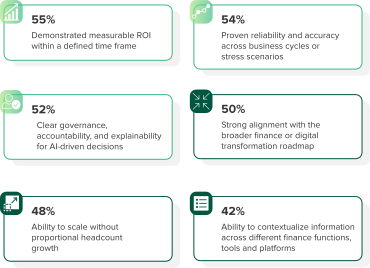
Funding decisions are tied to demonstrable value and operational confidence. More than half of decision-makers prioritize measurable ROI (55%), proven accuracy (54%), and clear governance and explainability (52%) when scaling AI initiatives (see Figure 8). As a result, finance leaders are requiring clearer metrics and greater assurance before moving from pilots to enterprise grade deployment.8
-
Yet, proving ROI has become significantly harder. In the study, 40% of decision-makers report difficulty moving beyond short-term productivity gains, while 53% identify this as the top challenge at the pre-adoption stage. This reflects that many organizations struggle to articulate longer-term value such as revenue impact, improved decision quality, or strategic advantage, which slows the transition from pilots to scaled deployment.
This challenge is most pronounced in strategic, judgement-driven functions, where value is more closely linked to business growth and expansion. Corporate development and investor relations show the largest shifts towards business expansion (+22%) and loss reduction (+20%), reflecting a broader enterprise pattern in which AI investment is expected to demonstrate clear, defensible business outcomes.
Figure 8
Key Outcomes Required To Justify AI Investment In Finance
Base: 1,279 global decision-makers with responsibility and/or influence in the organization’s financial operations
Source: Forrester's Q1 2026 Intelligent Finance Operations Survey [E-66799]
-
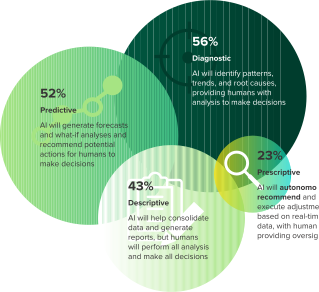
Autonomy is increasing but accountability remains firmly with humans. Decision-makers expect AI to play a greater role in higher-value decision support rather than full autonomy. More than half of decision-makers prioritize diagnostic capabilities (56%) and predictive capabilities for forecasting and scenario modeling (52%) (see Figure 9). In contrast, progress toward more advanced AI execution remains measured, with the average share of workflows that are autonomously executed expected to increase only from 11% to 16% over the next 12 months.
Whether autonomy advances further depends on structural conditions across industries. Financial services, technology, and business or professional services appear to be pulling ahead, with 15% to 19% of decision-makers reporting autonomous AI execution, compared with just 5% to 9% who share the same sentiments across the travel and hospitality, advertising and marketing, retail, and media and entertainment vectors.
Regional differences further shape the pace of autonomy. North America appears to be pulling ahead, with 19% of finance teams reporting autonomous AI execution, compared with 15% in EMEA and 16% in APAC. Within EMEA, the UK stands out in more advanced adoption, reflecting a more pro-innovation regulatory approach compared with parts of the EU.9 In APAC, China lags in enterprise finance adoption despite strong overall AI maturity, likely due to lower pressure to automate back-office processes where labour costs remain relatively low.
Figure 9
Expected Impact Of AI On Financial Insights And Decision-Making In The Next 12 Months
Base: 1,279 global decision-makers with responsibility and/or influence in the organization’s financial operations
Source: Forrester's Q1 2026 Intelligent Finance Operations Survey [E-66799]
What Wins Next: Owning AI Outcomes While Partnering To Scale
Looking ahead, finance teams are rethinking how technology, vendors, and internal capabilities come together to support AI expansion. Ownership is shifting inward, with finance teams taking greater accountability for outcomes while continuing to rely on external platforms and partners to manage integration, complexity, and risk. This shift elevates the importance of orchestration as AI expands across systems and workflows.
-
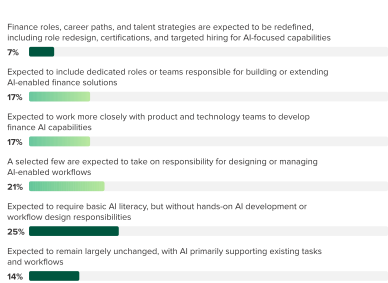
Finance teams are taking greater ownership of designing and managing AI-enabled workflows. More than half of surveyed decision-makers expect finance teams to play a direct role in building these workflows, whether through dedicated roles (17%), closer collaboration with technology teams (17%), or having selected staff lead workflow design (21%) (see Figure 10).
This shift requires a new set of capabilities. Skills such as prompt engineering, AI literacy, and workflow design are becoming as critical as traditional expertise as teams move from using AI tools to operating AI-enabled processes.
-
Finance is scaling AI through a hybrid model, rather than building everything in‑house. Even as finance teams take greater ownership of AI‑enabled workflows, they continue to rely on a mix of internal capabilities and external platforms. Today, 51% use this hybrid model, and this figure is expected to rise to 57% over the next 12 months (see Figure 11).
This reflects a deliberate shift toward configuring and integrating AI within existing finance systems, rather than developing solutions from scratch. In fact, 43% of decision-makers expect AI capabilities to be primarily delivered through vendor platforms, with internal teams focusing on orchestration, integration, and control.
Figure 10
How Finance Roles Will Evolve With AI Adoption In The Next 12 Months
Base: 1,279 global decision-makers with responsibility and/or influence in the organization’s financial operations
Source: Forrester's Q1 2026 Intelligent Finance Operations Survey [E-66799]
-
Scaling AI in finance is complex and risk-intensive, driving reliance on external expertise. While finance teams may be capable of developing AI solutions, complexity increases significantly once audit, compliance, and reporting requirements are applied. These demands make fully in‑house development difficult to sustain without proven safeguards.
As one senior finance director in the UK technology sector notes: “We almost always buy rather than build. Our engineers will say, “We can build that, it’s straightforward,” but once we walk through requirements like auditability, SOC 1 reporting, and control frameworks, it becomes clear how complex it really is.”
This shift is expected to accelerate even in relatively more advanced markets. In Singapore where AI adoption in finance teams is relatively higher, organizations are projected to reduce in-house development from 32% to 17% over the next 12 months while significantly increasing investment in hybrid models (from 38% to 66%), reflecting a growing preference for balancing internal capabilities with external expertise.
Figure 11
Sourcing Of AI-Enabled Finance Capabilities
Click to see data by region Hover to highlight data by countries, click to hide countries from the chart for comparison.
[CONTENT]
Base: 1,273 global decision-makers with responsibility and/or influence in the organization’s financial operations
Source: Forrester's Q1 2026 Intelligent Finance Operations Survey [E-66799]
-
Orchestration is emerging as a critical requirement. Orchestrating workflows across the broader finance ecosystem (66%) and adopting flexible, platform-based architectures (65%) are the top two criteria in vendor selection (see Figure 12). Looking ahead, scaling AI will depend less on adding new platforms and more on how effectively data, systems, and workflows are connected across the finance stack. Configurable platforms that enable orchestration are therefore better positioned to support incremental and sustained AI adoption over time.
POLL
Figure 12
Which Criteria Will Be Most Important For Your Organization When Selecting Third-Party Vendors For Their AI-Enabled Finance Capabilities? (Select One)
Base: 948 decision-makers and influencers of their organization’s finance strategy and workflows who indicated that their organization will engage third-party providers for AI-enabled finance capabilities in the next 12 months
Source: Forrester's Q1 2026 Intelligent Finance Operations Survey [E-66799]
Key Recommendations
Achieving sustained AI adoption in finance requires more than technology adoption — it demands disciplined operating choices. Organizations must align their AI ambitions with their structural readiness, operating capabilities, and risk tolerance, while leveraging platforms and partners to scale consistently without losing accountability.
Forrester’s survey of 1,279 global decision-makers and in-depth interviews with six finance leaders responsible for their organization’s financial operations highlight several key recommendations:
Appendix A: Methodology
In this study, Forrester conducted an online survey of 1,279 participants and six in-depth interviews with decision-makers at global organizations to evaluate intelligence in Finance operations and workflows. Survey participants included decision-makers in their organization’s financial operations. Questions provided to the participants asked about the current state of AI in finance across businesses globally, challenges faced, and future opportunities towards autonomous finance. Respondents were offered a small incentive as a thank you for time spent on the survey and interview. The study began in February 2026 and was completed in March 2026.
Appendix B: Demographics/Data
Region
| Company HQ | % |
|---|---|
| Australia | 8% |
| China | 12% |
| Hong Kong | 8% |
| New Zealand | 8% |
| Singapore | 8% |
| France | 8% |
| Germany | 8% |
| Israel | 8% |
| The Netherlands | 8% |
| UK | 12% |
| US | 12% |
Market presence
| Operating model | % |
|---|---|
| Operates in a single country | 26% |
| Operates in multiple countries within the same region | 30% |
| Operates in multiple countries across different regions | 44% |
Revenue
| Annual revenue | % |
|---|---|
| $500M to just under $1B | 3% |
| $1B to just under $3B | 57% |
| $3B to just under $5B | 27% |
| More than $5B | 14% |
Industry
| Respondent industry | % |
|---|---|
| Financial services, and/or insurance | 13% |
| Business and/or professional services | 11% |
| Technology and/or technology services | 11% |
| Retail | 11% |
| Advertising and/or marketing | 11% |
| Travel and hospitality | 11% |
| Media and entertainment | 11% |
| Other industry | 22% |
Company size
| Number of employees | % |
|---|---|
| 201 to 400 employees | 23% |
| 401 to 600 employees | 27% |
| 601 to 800 employees | 27% |
| 801 to 1,000 employees | 23% |
Position
| Respondent title | % | |
|---|---|---|
| C-level executive (e.g., CEO, CFO) | 20% | |
| Vice president (i.e., in charge of one/several large departments) | 27% | |
| Director (i.e., manages a team of managers and high-level contributors) | 36% | |
| Manager (i.e., manages a team of functional practitioners and/or leads projects) | 17% | |
Department
| Respondent department | % | |
|---|---|---|
| Corporate development and investor relations | 15% | |
| Finance | 85% | |
Finance functions involved
| Business functions | % | |
|---|---|---|
| Financial planning, analysis, and strategy | 49% | |
| Accounting, control, and close | 37% | |
| Finance operations (e.g., AP, AR) | 40% | |
| Treasury and capital management | 25% | |
Responsibility
| Finance strategy and workflows responsibility | % | |
|---|---|---|
| I am the final decision-maker for my organization’s finance strategy and workflows | 43% | |
| I am part of a team making decisions for my organization’s finance strategy and workflows | 34% | |
| I influence decisions related to my organization’s finance strategy and workflows | 24% | |
AI adoption
| Stage of AI adoption in finance workflows | % | |
|---|---|---|
| My organization is interested and planning to adopt AI in finance workflows within the next 12 months | 4% | |
| My organization is experimenting/piloting AI in finance workflows | 12% | |
| My organization has adopted AI in some finance workflows but does not plan to expand adoption within the next 12 months | 35% | |
| My organization has adopted AI in some finance workflows and plans to expand adoption within the next 12 months. | 41% | |
| My organization has adopted AI across most or all finance workflows | 8% | |
Appendix C: Supplemental Material
Related Forrester Research
“Top Agentic AI Use Cases For AP Automation In 2026,” Forrester Research, Inc., April 14, 2026.
“Navigate The Accounts Receivable Automation Ecosystem,” Forrester Research, Inc., January 15, 2026.
“The Finance Planning And Analysis Transformation Imperative,” Forrester Research, Inc., September 5, 2025.
“The ROI Of Finance Automation,” Forrester Research, Inc., December 9, 2025.
Appendix D: Endnotes
1 Source: To Make Agentic AI Automation Work, You Need A Process Mindset, Forrester Research Inc., May 7, 2025
2 Source: The CIO’s Guide To AI Readiness, Forrester Research Inc., January 23, 2026.
3 Source: Five Architectural And Technological Questions You Must Address In Your Data And AI Strategy, Forrester Research Inc., January 26, 2026.
4 Source: Best Practices To Optimize AI Data Fabrics, Forrester Research Inc., February 5, 2026.
5 Source: The Reference Architecture For Adaptive Process Orchestration, Forrester Research Inc., April 10, 2026.
6 Source: The CIO’s Guide To AI Readiness, Forrester Research Inc., January 23, 2026.
7 Source: The Forrester Data And AI Governance Model, Forrester Research Inc., July 17, 2026.
8 Source: Introducing The Forrester AI Value Matrix: A Framework For Measuring What Matters, Forrester Research Inc., April 24, 2026.
9 Source: Department for Science, Innovation & Technology, A pro-innovation approach to AI regulation: Government response to consultation, February 2024.
Consulting Team:
Tamira Lee, Market Impact Consultant
Siding Wang, Market Impact Consultant
Christie Yeo, Associate Market Impact Consultant
Yi Qin Teow, Principal Market Impact Consultant
Contributing Research:
Forrester’s Technology research group
Published
June 2026
 PDF
PDF